Wednesday, 25 February 2015

Gear Breakages on the Road

It's a sad fact that even if your travel is luxurious, things get lost, broken or just disappear while travelling.  Photographers probably have the worst of it as they tend to travel with an inordinate amount of additional gear, from lenses to computers , cables and of course filters. I got a shock when I pulled my 24-105mm lens out of the bag today to see the filter glass shattered.  It's never happened before and annoying seeing that it was only a week old.  All you need is a tiny nick in the edge of the glass element, then a slight knock, and it cracks.


Just in case I usually travel with a second camera body - in case disaster strikes – luckily I have never lost a camera.  But I have dropped a few resulting luckily in only surface scratches but a larger bar bill for that evening.   I had a scare getting out of a taxi in Dubai recently. My Canon EOS 5D MkIII crashed onto the concrete floor - with no apparent damage, despite the noise it made.  It was only then I realised that it had become detached from my Carryspeed camera strap. On closer inspection it appears that the ball part of the universal joint was excessively worn – essentially the weight of the camera pulled the socket apart sending it onto the pavement. 
Carryspeed (apparently) is locked in a copyright dispute with Black Rapid over patent infringements so I couldn't complain to the company as there is no contact page.  Luckily I managed to get a replacement strap in a local camera store.

Copyright infringement or not, I think Carryspeed has a far better product because it has a better anchoring point on the camera – Black Rapid straps attach via a screw thread into the tripod screw socket. Carryspeed straps attach to a plate which attaches to the bottom of the camera. This plate has no less than 6 tripod screw holes - the plate itself fits Arca Swiss style QR heads so you don't have to unscrew the strap to attach the camera to a tripod.  My new version strap has a far better ball and socket locking mechanism that I hope will never let go of the camera.  If you have one that looks like this model and you regularly use heavy lenses, might be an idea to have the ball socket checked out so you don't experience the same disaster...

Russian Remnants among Religious Relics

A fancy plant holder - bougainvillea growing out of the rear access doors to this Russian BMP APC
We saw this vehicle parked up in the front of the hotel in Bahir Dar - I asked why a Russian APC (armoured personnel carrier) was on display in the hotel - "souvenir of the war from the 70s" was the answer.  At that time the Derg, a socialist revolutionary party took control of Ethiopia backed by the Soviets who, of course, flooded the area with 'aid' - in this case an 8-man wheeled BMP 1 (I think this is the model - most were tracked).
This could hold 8 troops, plus a driver and commander. 
It was not only totally amphibious but it was also designed to provide protection from nuclear and biological warfare as well.
Quoted from Wikipedia: "The  BMP-1 is a Soviet amphibious tracked infantry fighting vehicle. BMP stands for Boyevaya Mashina Pekhoty 1, meaning "infantry fighting vehicle".  The BMP-1 was the first mass-produced infantry fighting vehicle (IFV) of USSR.  It was called the M-1967, BMP and BMP-76PB by NATO before its correct designation was known".


Tuesday, 24 February 2015

A Short Walk up the Blue Nile

It was not the best time to shoot rushing waters of the Blue Nile - but we didn't have much of a choice.  We flew into Bahir Dar from Addis at 9am and after a bone-shattering hour on a dirt road arrived at the falls national park.  As is often the case in these places we took on a local guide who was handy for carrying tripods but not a lot else.  Waterfalls don't require a lot of explaining.  Being the dry season very little water was going over the drop - local authorities built a hydro station round the corner that consumes most of the flow headed for the waterfall - but we were lucky in that the generating plant had broken down the week before so the flow was quite impressive.  From here the Blue Nile flows some 5200kms to Alexandria. 

To get the smoke like effect I used an ND 64 filter (which turns the image in the viewfinder almost black) this produced a 4 second exposure and a nice smooth water effect.  While it sounds like the ideal solution, using the ND64 is hard because it's so dark you simply cannot clearly see if the image is in focus or not...

Here's the group crossing a thin suspension bridge next to the Blue Nile falls
Small local boat acting as a ferry to get across the relatively smooth waters of the Blue Nile

Sunday, 22 February 2015

Mercato Madness

Mercato, in central Addis Ababa, is reputed to be the largest market in Africa.  When you are driving through Mercato you feel like it has no end or beginning - it's just an endless stretch of ramshackle huts, shops, sheds and tents, housing every conceivable kind of product.  From donkeys to electrical wiring, (re)polished second hand saucepans, tools, heaters, beds, linen, chillies, kat (a mildly addictive plant leaf that the Ethiopians chew), cars, car parts, tailoring - you name it, it's there...

Some of the donkeys appear to have owners, like these two,
but we also saw plenty of others just trotting off apparently by themselves through the traffic and throngs of people...
I wasn't sure what these two were up to - maybe they had lost their donkeys?
You would not know from this picture  -  this is a chilli grinding shed.
The smell even from the relatively safe confines of the van was almost eye watering.
These shops sell whole large chillies or the powder.
Trying to make sense of the mountains of recycled vegetable oil containers (in yellow) as a visitor is hard but in this section of Mercato this is a living...

Iconographic Addis Ababa

Spent the day in Addis Ababa's Holy Trinity cathedral, the National Museum (to see Lucy, the oldest hominid skeleton ever found)  and the Ethnological museum - both of which appear, at least form the outside to be past their prime and not that interesting.

Holy Trinity was OK, as was the national Museum,  but the Ethnological Museum was by far the best experience - stuffed with artifacts relating to the lives of Ethiopians from different regions of the country. 

The cool thing is that you can take photos in the museum (although flash is not permitted) so we all had a grand time snapping away at the exhibits.  No flash? Easy with high ISO - most were shooting at 800, 1600 and even ISO 3200 to get sharp results in some of the darker corners of the museum. 

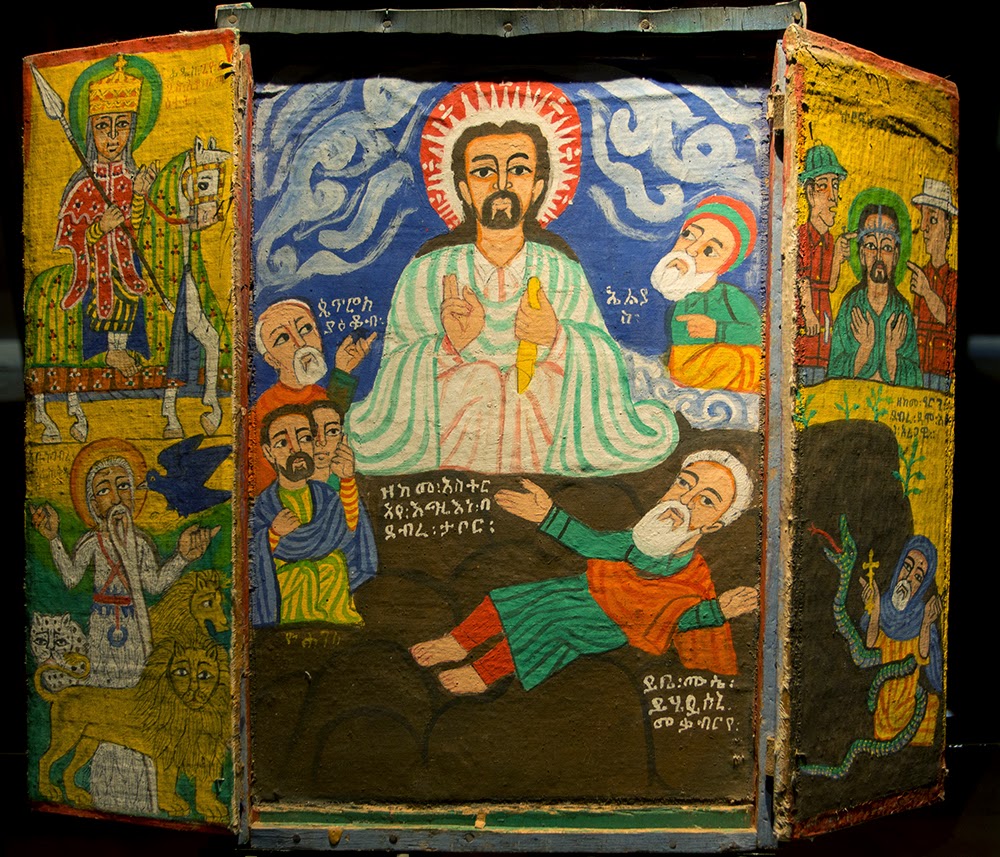
As you can see from these images, my absolute favourites were the religious icons. These are quite primitive compared to what you might expect to see from Russia and other Eastern Bloc countries, but nevertheless they have a cuteness about them that I found very endearing.


Very graphic images of what might happen if you don't toe the line...


Saturday, 21 February 2015

Addis Ababa - First Impressions

Addis Ababa is a serious melting pot of cultures, with a very long history (see Lucy, the oldest hominid skeleton ever discovered in the country's Afar region), a manic building boom that makes Dubai look slovenly and massive urban growth...

Minibus ticket guy touting for that last passenger.
Most of these local minibuses look in pretty bad shape
Early morning light walking into the church grounds with a bunch of local pilgrims
Panorama of a church located near our first hotel.
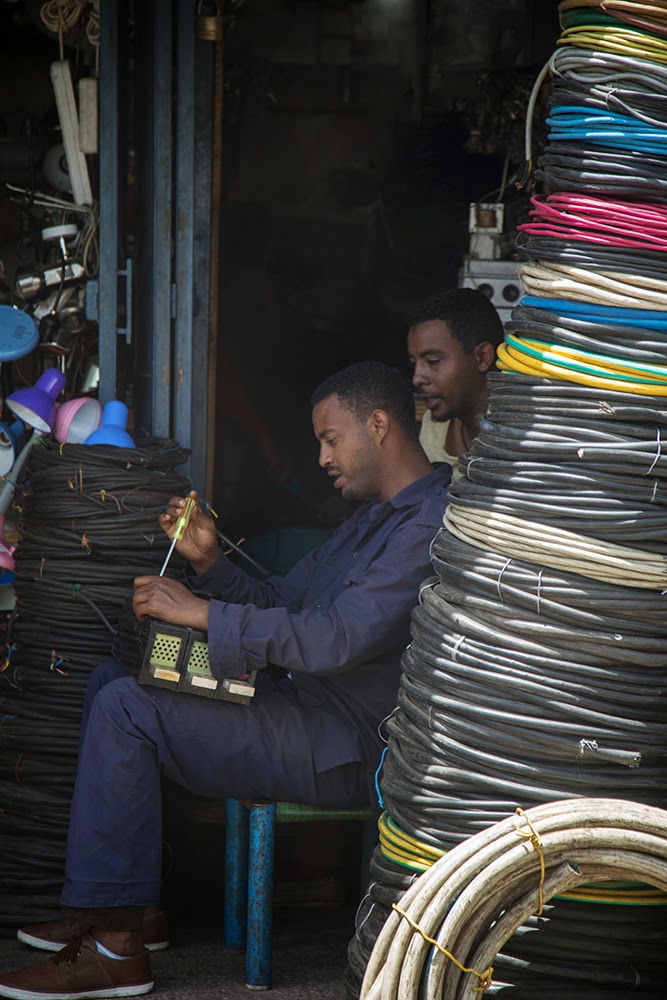
Donkeys being used to carry freight into Mercato, a massive market area selling almost anything you can imagine including recycled tin, plastics, wire, motor parts and much more. It was a cacophony of noise, diesel fumes, mixed with a tight press of humanity all going about their daily chores
Two men in a Mercato cable recycling shop
Mercato again - this was a market created purely for indigenous peoplecreated by the Italians, segregating them from the Italian areas around the Piazza part of the city. 
Here's a glimpse down one alley where everyone clearly specialises in recycling anything plastic - and especially anything yellow plastic!
View from hotel window at 6am.
Addis is experiencing a staggering building boom - although not quite on the sheer size of Dubai's skyscrapers, almost every second or third building is either new or under construction - which makes the pace look a terrible mess.
HDR of the old Djibouti to Addis Ababa railway station - it is no longer in use but is soon to be converted into a museum - the new rail line is being brought into a different part of the city.
And what would a railway station be without a proper station restaurant - and bar.
Another HDR image.

Friday, 20 February 2015

A Middle Eastern Brekkie


Heading up to Addis Ababa from Sydney, I stopped in Dubai for a night just to recover from the 14-hour flight from Australia before meeting the rest of my photography tour group in Ethiopia.  
 I’d forgotten what a Middle Eastern breakfast could be like: expansive, tasty and completely different to anything you are likely to experience on the West.
Main dishes include ful mesdames (centre, top), which I believe is originally from Egypt, a mixture of fava beans, garlic, onions and spices, hummus (of course - it's the Middle East)), labneh, a fantastic dip - a cross somewhere between yoghurt and cream cheese, haloumi cheese, salad, and eggs, usually fried and placed on top of the ful. Then of course there’s coffee and Arabic style bread to mop up the mess. Delicious.

(Canon EF 24-105mmm f4 lens, 1/40s @ f4, ISO 1000).

Tuesday, 17 February 2015

Right Signature, Wrong Message

I think we have all had to experience this rather dubious form of signatorial acknowledgement at one time or another - the delivery of a package, or registered post, etc.  I dislike the concept because it's impossible to sign a tiny electronic device with a plastic lolly stick masquerading as a pencil - and still produce a signature that looks genuine.  If it looks like you gave the pencil to a chimp, why bother at all?


A couple of days ago I had some broadband cable work done and as the guy was heading for the door to leave, I asked if I had to sign for the work.  He'd forgotten but quickly produced a mobile and brought up the contract page (I assumed that was what it was - I didn't have time to read it).  Problem was he couldn't find a stylus for the signature.  Instead he picked up a 7-inch screwdriver I'd left on the hall chest and said that would do. 

I can still hear the scrape as its hardened steel tip etched an illegible electronic scrawl into the signer's box.  The noise wasn't quite as bad as fingernails down a blackboard, but it was close.  The phone screen was never going to look the same again.

Before Christmas I had occasion to sign my casual employment contract.  This was something that previously had been done by hand using pen and paper - but was now all digital using a product called Right Signature.  You receive a PDF document and scroll to the point where a signature is required.  A box then magically appears into which, according to the instructions, you 'write' your signature.  I was at a loss because, though a pen/stylus might work on an iPad, it wasn't going to work on my 24-inch Eizo monitor.  I checked the company website for help.  Its told me all that was required was an "effortless signature" using a mouse.  Has anyone ever been able to produce an accurate or legible signature with a mouse?  I doubt it.  It's like drawing with a house brick. The two processes, handwriting and computer screen, just don't go together.  I practiced for 40 mins, eventually producing a signature that sort of looked about 50% like my regular one - it wasn't very authentic.  I wondered about the legal veracity of this kind of contract.  According to its online information, Right Signature is a perfectly legal way to gather signatures from employees in situations such as this - thus speeding up processing in companies that need large numbers of signed confirmations in a hurry.  OK for the finance department perhaps but, after I'd finished checking it online, I practiced with a mouse and eventually on an iPad (which was even harder than a mouse) I'd lost two hours of my day - and collected a few more grey hairs.  I checked Right Signature again to see if this was legal for all 'legal' documents - and it's not. For anything that really matters, births, deaths, marriages, divorces and a whole heap of other situations, it definitely is NOT legal.  Interesting.

I write this partly because my signature is very hard to recreate with a mouse or even one finger (as was suggested in the online tutorial) and that's the point of a signature.  It's not supposed to be easily re-created using non-standard devices.  Being able to flawlessly forge signatures by hand was a skill that saved many from certain death in WWII.  You can imagine a different outcome if all they had in those times was an electronic finger painting pad on which make a forgery.

My father was a solicitor and spent his entire working life based around the authenticity of the signed document.  Fortunes, houses, inheritances and more all relied on the authenticity of hand written signatures.

Now all that's needed is a scrawl in an electronic window that bears little resemblance to a real, hand written signature, but which is now sufficient proof to be employed.

While on signatures, I have to confess.  Many years ago I worked for an audio visual company that ordered a lot of film processing.  In those days anyone taking film to the lab had to have a purchase order with a sales tax exemption clause signed by the 'authorised company' signatory.  Essentially anyone taking film to the lab scribbled on it - no one took a blind bit of notice whose signature it was, or whether it was legible.  I thought this was a stupid bit of bureaucracy so tried an experiment.  Every time I went to the lab, I signed with someone else's name - just to see how effective this safeguard was. 

I started with the names of various global despots such as Robert Mugabe, Saddam Hussein, Jo Stalin, to name a few.  No one remarked on the oddly-named people authorising the sales tax exemption for weeks so I stirred the pot a bit more, using the names of high ranking Nazis: Bormann, Eichmann, Hess, Himmler, Heydrich, etc.  Still no reaction.  I think my somewhat sad little scheme continued for more than a year before another employee noticed one of my sales dockets, signed by Adolf Hitler - then the alarm bells rang.  I didn't lose my job (probably  should have) but it sort of highlighted the uselessness of having to blindly sign a document in this way.

I could go on.  Remember when the government knee jerked over terrorist threats in Australia?  Suddenly you could no longer send a parcel interstate unless you signed a docket on the outside to the effect that it contained no "dangerous goods".  No one ever seriously checked this signature with photo ID which kind of made that declaration rather superfluous....


All of this essentially spells out the demise of the written word. Electronic devices diminish the beauty of the hand-crafted signature.  We increasingly rely on electronic devices to provide reading material and the feel of paper between your fingers as you flick the pages is soon to be a distant memory.  

But then, if I hadn't used a computer to write this, and accessed the Internet to post it online, no one would be any the wiser...

Monday, 26 January 2015

The Price of Technology: Inbuilt Redundancy

One aspect of living in a modern consumer society is the inbuilt redundancy many of the devices we use exhibit (I'm sure I'm not the first to grumble about this - but I'm going to anyway...).

I've been ordering third party inkjet refills online from www.wholesaletoner.com.au for a few years.  Its service is excellent. Prices are 60% cheaper than genuine cartridges (for much the same quality, their generic inks are made in the US), product arrives in only a couple of days, and I don't pay postage on orders over $50.  Even better, late last year I got hold of a discount offer coupon, so ordered $150 worth of inks - probably enough for a year or more.  I thought that was good economics.

The cartridges arrived but two weeks later the Canon multifunction printer (a Pixma MX715) stopped working. Error 'U052', a clear sign (according to the Internet) that the print head was dead, and only three years old.  Some might say that's all you can expect from devices like this.  A quick search for a replacement MX715 came up empty - there had been at least two generational upgrades since that model was released.

A search for a suitable repair company proved a joke - despite advertising "we repair all inket printers" or words to that effect, the three companies I called didn't want a bar of it - not enough money in repairing home-use printers I guess.  I eventually tracked down a Canon service agent via a call centre in Manila.  Amazingly it was just round the corner in the same suburb, but, not surprisingly the quote was $165 for labour, plus the replacement spare part ($60). I checked - the latest model multifunction unit is costs $139.  


Direct Office Machines clearly advertise Pixma repairs on their site, but would not take my multifunction in for repair...
I'm sure many of you have been there - but my problem was the veritable stockpile of ink cartridges  I 'd got on the cheap.  The new multifunction units take a new type of ink tank - of course. They look very similar in shape and size - but they are not the same. Doesn't that piss you off?  Inkjet inks were recently quoted as being one of the most expensive liquids on the planet, dwarfing the per volume cost of many famous perfumes.  It's become a market that's very carefully guarded.  

In 2014 the global inket ink market was worth over $6 billion whereas the overall market (inks, printers and media) was valued around US$33 billion - which is forcasted to rise above $60 billion by 2019 - so you can appreciate Canon and Epson were never going to listen to my complaints about ink costs, or anyone else for that matter. 

Remember the propaganda put out by Epson and Canon a few years back trying to discredit the quality of generic inks, including adding digital chips into the cartridges to prevent other vendor's products being used in the printer?  Admittedly some of the earlier refill products were dodgy but now I think most quality refills are actually very good - I have been using them for years and have been very happy with the results.  Generics might not perform 100% the same as a genuine ink, but at $9.50 versus $27.50, per cartridge, I'm quite prepared to bring my expectations down 5% to save a bucket load of cash over the period of a year or so.

Years ago, whenever I was invited to a press launch of a new printer range, I used to take the opportunity to berate the producer, usually Canon, for the high cost of inks. 

I travel to Japan a lot and there, inks for the same model printers are about $10, less than half the price charged here.  When asked, Canon's take on that was because the printers themselves were expensive compared to Aus.  Not so, in fact, at the time I did a lot of research on the topic and discovered that they were usually the same price, or cheaper.  Sad truth is that in this market, among many others, we are being royally shafted at every possible opportunity.  Though I'm talking about the inkjet market, we all know this is a familiar story when it comes to many other prices overseas.


We keep buying the stuff at ridiculous over-inflated prices so companies continue flooding the retail market with new products that, frankly, we really don't need.  Wouldn't it be nice to have an inkjet printer that lasts 10 years?

At the end of the day, once again, thanks to Wholesale Toners, I got a full refund on my ink mountain and a new printer for $89.

Small wonder brand name cartridges cost $27 each.


Thursday, 15 January 2015

Camera Essentials Magazine

Camera Essentials - this is a 76-page magazine/handbook (8.5x11 inches) I have been working on and off on for more than a year now.  It has changed shape and page numbers several times since I first began writing it, but it's now complete and is available through the Blurb Bookstore here.  Alternatively you can order directly from me - cost $25 inc. postage and handling. 

Who is this for? Camera Essentials is written specifically for anyone wanting learn a bit more about their interchangeable lens camera (DSLR, small form or FourThirds models) - to learn about lens types, camera features and functions, the reason we use ISO, aperture and shutter speed, exposure compensation, exposure bracketing, shooting modes, focus modes and much more.


Thursday, 8 January 2015

Daydream Mine, Broken Hill

Daydream Mine is one of the more off-beat attractions in Broken Hill, the biggest settlement in north west New South Wales.  I write 'attraction' because it's one of only a very few original mines that I know of where you can actually experience, with the minimum of fuss from the health and safety people, something of the true nature of what mining must have been like 150 years ago.

OK, you don't get to actually work the rock face for 12 hour shifts in near black conditions with only a single candle as a light source, nor do you have to suffer the disgusting lung damage created by breathing in the airborne mica fibres all day long (that left most miners dead by the age of 35 coughing up their lungs), neither do you get to experience the immense burst of pressure when the mine ceiling collapses, killing all in its wake - not from falling debris but from the intense pressure, but you do get an inkling of what it must have been like.  A hard place to photograph in as there was no time to stop for tripod work, not much light for the AF in the camera to work off and no room to manoeuvre, but I think you get the picture...


Innocent enough.
This small hole is one of the entrances to the Daydream Mine. 
Not the one we went down thank goodness, a near vertical shaft down into the ore lode beneath.
No safety rails, no ventilation, no decent lighting and of course, no safety precautions. Those were the days. 
The amazing fact about early mining  was that, to begin with at least, there were no facilities for processing the ore on site - all the ore was carted from Daydream by bullocks to the nearest rail head, then trained to Adelaide then shipped to smelter in South Wales (UK).

This shot gives you a good idea of what it was like getting down to level one -  steep, very roughly-hewn steps into the bowels of the earth with less than enough head room (you'll be very happy to wear the helmets!), a single flimsy hand rope and plenty of opportunity to sprain ankle - I wouldn't have missed it for the world.
This is one of the side shafts, blasted to help clear some of the 96,000 tonnes of silver lead ore that was eventually extracted and shipped to the smelters over a short period of 20 years.
The way out at last! You can clearly see where the poor grade ore or rock has been used on the right hand side of the mine to support the roof that has been undermined.
Apparently kids were employed as graders sorting the ore-rich rock from the rubbish. 
The former was manually dragged to the surface while the latter was used to back fill the workings.